

(best
viewed at 800 x 600)
| Learning Styles | |||
|
|||
|
Untools
https://untools.co/ Untools Collection of thinking tools and frameworks to help you solve problems, make decisions and understand systems. |
||
 
|
||

|
||
|
SAGE : A Framework for Project-Based Learning
https://www.teachingchannel.org/videos/pbl-sage-framework-asis SAGE : A Framework for Project-Based Learning |
||
|
|
||
|
|
||
|
How a Radical New Teaching Method Could ...
http://www.wired.com/business/2013/10/free-thinkers/all/ How a Radical New Teaching Method Could Unleash a Generation of Geniuses For the time being, we can see what the future looks like in places like Juárez Correa’s classroom. We can also see that change will not come easily. Though Juárez Correa’s class posted impressive results, they inspired little change. Francisco Sánchez Salazar, chief of the Regional Center of Educational Development in Matamoros, was even dismissive. “The teaching method makes little difference,” he says. Nor does he believe that the students’ success warrants any additional help. “Intelligence comes from necessity,” he says. “They succeed without having resources.” |
||
|
|
||
|
|
||
|
Shamblesguru's Live Twitter Stream
https://twitter.com/shamblesguru Tweets by @shamblesguru |
||
|
|
||
|
|
||
|
The Networked Student : Connectivism
https://youtu.be/XwM4ieFOotA |
||
|
|
||
|
|
||
|
Projects And Project-Based Learning
https://bit.ly/19iBmOK The Differences Between Projects And Project-Based Learning There’s a big difference between using projects in the classroom versus project-based learning in the classroom. What are those differences, you ask? Lucky for you, friEdTechnology (great name) whipped up this snazzy side-by-side comparison outlining the biggest differences. In the visual, they describe what ‘projects’ are and how they work in the classroom. For example, projects can be done at home without teacher guidance or team collaboration. They are based upon directions and the folks from friEd say they’re “done like last year” (curious if you agree with that or not!) |
||
|
|
||
|
|
||
|
New Classrooms Overview Part 1
https://youtu.be/abRtYNkmBao |
||
|
|
||
|
|
||
|
Connected Learning
http://connectedlearning.tv/ Connected Learning There is wide agreement that we need new models of education, and not simply new models of schooling, but entirely new visions of learning better suited to the increasing complexity, connectivity, and velocity of our new knowledge society. We now have the capability to reimagine where, when, and how learning takes place. Read the Connected Learning Report : A research synthesis report of the Connected Learning Research Network |
||
|
|
||
|
|
||
|
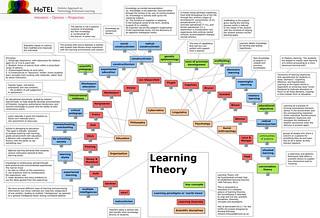
The Wheel of all learning theories
https://bit.ly/1a4mS3E The Wheel of all learning theories "I really feel like there are no words that can ever give credit to the phenomenal work put into creating the wheel below. It just amazed me how much time invested in it."
|
||
|
|
||
|
|
||
|
Blended Learning
http://www.infinitethinking.org/305---blended-learning.html |
||
|
|
||
|
|
||
|
Universal Design for Learning UDL Videos
https://bit.ly/14MBV3D Universal Design for Learning Universal design for learning (UDL) is the practice of embedding flexible strategies into the curriculum during the planning process so that all students can access the curriculum. If UDL is implemented meaningfully, then it greatly reduces the need for retrofitting accommodations for individual students. The needs of individual learners are met through flexible teaching and carefully planned choices for all students to demonstrate their knowledge. |
||
|
|
||
|
|
||
|
Three fears about blended learning
http://wapo.st/WnEwvJ Three fears about blended learning The tech revolution has led many to see a future where students get their education through a blend of traditional learning in classrooms and instruction through computer or other tech device. Here, John Merrow, veteran education reporter for PBS, NPR, and dozens of national publications, writes about this key concerns about blended learning. |
||
|
|
||
|
|
||
|
How We Learn What We Learn
http://issuu.com/rosendale/docs/how_we_learn |
||
|
|
||
|
|
||
|
Learning in a Digital Age
https://youtu.be/ervfM-eubn8 |
||
|
|
||
|
|
||
|
Good, Bad, and Ugly of Blended Learning Policies
https://bit.ly/OPs0kF The Good, Bad, and Ugly of Blended Learning Policies In the fifth installment of their monthly column, blended learning experts Michael B. Horn and Heather Staker discuss the policies prohibiting and fostering the growth of blended learning. |
||
|
|
||
|
|
||
|
ICT-Supported Project-based Learning [PBL]
https://bit.ly/Mi8b0t ICT-Supported Project-based Learning: the Myths and Truths The purpose of this article is to facilitate the effective enactment of PBL by breaking some of the misconceptions that teachers may have. Those misconceptions sometimes hold teachers back from taking the first step towards ICT-supported project based learning; other times, those misconceptions cause teachers to abuse PBL approaches. We hope that this article helps teachers make a right decision on using PBL or other student-centred approaches with ICTs. |
||
|
|
||
|
|
||
|
The Muppets Guide to Project-Based Learning (PBL)
https://bit.ly/KxkYPg The Muppets Guide to Project-Based Learning (PBL) |
||
|
|
||
|
|
||
|
Project Based Learning Explained
https://youtu.be/LMCZvGesRz8 |
||
|
|
||
|
|
||
|
'New' Blended Learning Definition
https://bit.ly/ICFfAy “New” Blended Learning Definition Heather Staker and Michael Horn have done an admirable job of further defining “blended learning” in their latest white paper from the Innosight Institute. Creating a definition that illustrates something that is not clearly known by those not in the field is a challenging task. |
||
|
|
||
|
|
||
|
Born to Learn
https://bit.ly/y2sMF5 |
||
|
|
||
|
|
||
|
5000 Year Timeline of Learning Theories
http://vimeo.com/15448054 5000 Year Timeline of Learning Theories from Dallas McPheeters on Vimeo. |
||
|
|
||
|
|
||
|
Top Ten Tips for Assessing Project-Based Learning
https://bit.ly/gmJe2r Top Ten Tips for Assessing Project-Based Learning |
||
|
|
||
|
|
||
|
Learning Styles Quiz
https://bit.ly/hWxudY Learning Styles Quiz Get insight into how your child learns best. |
||
|
|
||
|
|
||
|
Bloom’s Taxonomy Bloomin’ Pinwheel
http://ilearntechnology.com/?p=3080 Bloom’s Taxonomy Bloomin’ Pinwheel |
||
|
|
||
|
|
||
|
An Introduction to Project Learning
http://www.edutopia.org/project-learning-introduction-video An Introduction to Project Learning In this hands-on approach to teaching, students create schoolwork that demonstrates core subject knowledge. Read a short introductory article or watch an in-depth video. Project Based Learning |
||
|
|
||
|
|
||
|
Multiple Intelligences in the Classroom
http://www.edutopia.org/multiple-intelligences-immersion-enota-how-to How to Address Multiple Intelligences in the Classroom Multiple-intelligences theory can provide a flexible approach to good teaching, say teachers and administrators at the Enota Multiple Intelligences Academy, in Gainesville, Georgia. |
||
|
|
||
|
|
||
|
Personal Learning Network PLN
http://www.shambles.net/csmith/pln/ Personal Learning Network PLN What does a PLN look like ... have a look at Chris Smith's own PLN .. which includes the use of several Web 2.0 tools |
||
|
|
||
|
|
||
|
5 principles of learning theories
http://cckno8.wordpress.com/ 5 principles of learning theories |
||
|
|
||
|
|
||
|
The Twenty-First-Century Digital Learner
http://www.edutopia.org/ikid-digital-learner-technology-2008 Young Minds, Fast Times: The Twenty-First-Century Digital Learner How tech-obsessed iKids would improve our schools. It is a measure of the malaise of our educational system that these old folk -- smart and experienced as they may be -- think they can, by themselves and without the input of the people they're trying to teach, design the future of education. One of the strangest things in this age of young people's empowerment is how little input our students have into their own education and its future. |
||
|
|
||
|
|
||
|
Brain Rules
http://www.brainrules.net/ The brain is an amazing thing. Most of us have no idea what’s really going on inside our heads. Yet brain scientists have uncovered details every business leader, parent, and teacher should know. How do we learn? What exactly do sleep and stress do to our brains? Why is multi-tasking a myth? Why is it so easy to forget—and so important to repeat new knowledge? Brain Rules is about what we know for sure, and what we might do about it. |
||
|
|
||
|
|
||
|
Blended Learning (Curtis Bonk )
http://www.trainingshare.com/pdfs/SFX35E4.pdf Blended Learning (Curtis Bonk ) presentation |
||
|
|
||
|
|
||
|
The (UK) Open Universitys OpenLearn
http://openlearn.open.ac.uk/course/category.php?id=12 The (UK) Open University's OpenLearn LDT101_3 Learning how to learn Welcome to The Open University's OpenLearn website - free and open educational resources for learners and educators around the world. You are in the LearningSpace where Open University learning materials are freely available for you to study in your own time, away from any formal teaching environment. Visit the LabSpace to share and reuse educational resources. Download some learning materials, adapt to your needs: translate, shorten, extend, add examples... and then of course, place it back for others to benefit! LDT101_3 Learning how to learn |
||
|
|
||
|
|
||
|
Thinking Tools from Intel
http://www.intel.com/education/tools/index.htm Thinking Tools from Intel Increase student learning with these interactive, online tools designed to promote higher-order thinking in any subject. Each tool features an online workspace where students create and save visual representations of their thinking. Classroom strategies and teacher-tested project ideas suitable for K-12 classrooms will help you get started. Visual Ranking Tool Students show their reasoning and discuss differences in their conclusions as they use the Visual Ranking Tool to prioritize and compare items in lists. Seeing Reason Tool Seeing Reason Tool prompts students to investigate cause-and-effect relationships in complex systems. Students use an interactive causal mapping tool to create maps that communicate their understanding. Showing Evidence Tool Students use the Showing Evidence Tool to construct a well-reasoned argument and defend it with credible evidence. The interactive workspace prompts students to assess sources and analyze evidence. |
||
|
|
||
|
|
||
|
What's Your Learning Style?
http://agelesslearner.com/assess/learningstyle.html What's Your Learning Style? Take a few minutes to complete the questionnaire to assess your preferred learning style. The column with the highest total represents your primary processing style. The column with the second-most choices is your secondary style. |
||
|
|
||
|
|
||
|
Tapping into Multiple Intelligences (workshop)
http://www.thirteen.org/edonline/concept2class/mi/index.html Welcome to Tapping into Multiple Intelligences. Hopefully, you'll tap into a few of your own intelligences to learn about this important theory. Start here in the Explanation section, which is all about the CONCEPT. Then go on to Demonstration, where we move from CONCEPT to CLASSROOM! |
||
|
|
||
|
|
||
|
Inquiry-based Learning (workshop)
http://www.thirteen.org/edonline/concept2class/inquiry/index.html Welcome to Inquiry-based Learning. Start here in the "Explanation" section, which is all about the CONCEPT. Then go on to "Demonstration" and the following sections, where we move from CONCEPT TO CLASSROOM! |
||
|
|
||
|
|
||
|
Introduction to Learning Styles
http://agelesslearner.com/intros/lstyleintro.html Introduction to Learning Styles This introduction puts learning styles information into easy to understand language and provides sources where you can learn more. I also offer a Learning Style Assessment that you can use to gauge your dominant learning style and techniques you can use to benefit from your individuality. Overview of learning styles | Books about different ways people learn | Links to other websites about learning styles | Learning Styles Indicator | |
||
|
|
||
|
|
||
|
What is Your Learning Style?
http://agelesslearner.com/assess/learningstyle.html Whatis Your Learning Style? .. Assessment / Evaluation Take a few minutes to complete the following questionnaire to assess your preferred learning style. |
||
|
|
||
|
|
||
|
Theory Into Practice (TIP) database
http://www.instructionaldesign.org/index.html Theory Into Practice (TIP) database TIP is a tool intended to make learning and instructional theory more accessible to educators. The database contains brief summaries of 50 major theories of learning and instruction. These theories can also be accessed by learning domains and concepts. |
||
|
|
||
|
|
||
|
Learning Styles Questionnaire
http://www.engr.ncsu.edu/learningstyles/ilsweb.html Online Learning Styles Questionnaire |
||
|
|
||
|
|
||
|
Study Guides and Strategies
http://www.studygs.net Learning to learn | Effective study habits | Managing time | Setting goals/making a schedule | Managing stress | Thinking like a genius | Mapping information | Motivating yourself | Making decisions/solving problems | Self-assessment web sites | Thinking critically | Concentrating | Memorizing | Organizing projects | Thinking aloud/private speech | Evaluating web site content | Citing web sites | Laying out a basic web page | Writing for effective web pages | Designing web sites | |
||
|
|
||
|
|
||
|
Inquiry-based Learning
http://www.thirteen.org/edonline/concept2class/month6/ Inquiry-based Learning. Welcome to Inquiry-based Learning. Start here in the "Explanation" section, which is all about the CONCEPT. Then go on to "Demonstration" and the following sections, where we move from CONCEPT TO CLASSROOM! What is inquiry-based learning? | How does it differ from the traditional approach? | What does it have to do with my classroom? | What are the benefits of inquiry-based learning? | How has inquiry-based learning developed since it first became popular? | What are some critical perspectives? | How can I use inquiry-based learning in conjunction with other educational techniques? | |
||
|
|
||
|
|
||
|
Learning Styles : wwwlinks
http://www.khake.com/page69.html Learning Styles : wwwlinks |
||
|
|
||
|
|
||
|
Learning Styles Questionnaire
http://www.engr.ncsu.edu/learningstyles/ilsweb.html Online Learning Styles Questionnaire For each of the 44 questions below select either "a" or "b" to indicate your answer. Please choose only one answer for each question. If both "a" and "b" seem to apply to you, choose the one that applies more frequently. When you are finished selecting answers to each question please select the submit button at the end of the form. |
||
|
|
||
|
|
||
|
The Learning Revolution
http://www.thelearningweb.net/ The Learning Revolution ... The Learning Web | Accelerated learning | ADHD | Brain based learning | Distance learning | | Emotional intelligence | Games - Learning Games | Games - Teaching Games | Games - Training Games | High School Dropouts | Home schooling | Ideas & Critical Thinking | Innovation and Thinking | Integrated studies | IQ tests and Intelligence | Kaizen | Learning Disabilities | | Learning organizations | Learning society | Learning styles | Learning by yourself | Memory Tricks | Mind mapping | Montessori | Music and earning | NLP | Phonics | Piaget | Quotes-Quotations for Learning | Reading Recovery | Ritalin | Schools of the future | Self esteem | Speed Reading | The Learning Revolution | TQM - Total Quality Mgt | |
||
|
|
||
|
|
||
|
All Kinds of Minds
http://www.allkindsofminds.org/ All Kinds of Minds All Kinds of Minds provides programs, tools, and a common language for parents, educators, and clinicians to help students with differences in learning achieve success in the classroom and in life. Founded in 1995, All Kinds of Minds is a private non-profit Institute, affiliated with the University of North Carolina at Chapel Hill, that offers a powerful system of programs for helping kids succeed. Our primary goal is to educate teachers, parents, educational specialists, psychologists, pediatricians, and students about differences in learning, so that children who are struggling in school because of the way their brains are ?ired?are no longer misunderstood. Our programs have been developed by Dr. Mel Levine and his colleagues based on scientific research and over twenty-five years of clinical experience. They provide a comprehensive framework for understanding how all kids learn. learning | styles | |
||
|
|
||
|
|
||
|
Learning Styles & Multiple Intelligence
http://www.ldpride.net/learningstyles.MI.htm Information about learning styles and Multiple Intelligence (MI) is helpful for everyone especially for people with learning disabilities and Attention Deficit Disorder. Knowing your learning style will help you develop coping strategies to compensate for your weaknesses and capitalize on your strengths. This page provides an explanation of what learning styles and multiple intelligence are all about, an interactive assessment of your learning style/MI, and practical tips to make your learning style work for you. |
||
|
|
||
|
|
||
|
Concept to Classroom
http://www.thirteen.org/wnetschool/concept2class/resources.html Tapping into Multiple Intelligences | Constructivism as a Paradigm for Teaching and Learning | Teaching to Academic Standards | Why the Net? An Interactive Tool for the Classroom | Cooperative and Collaborative Learning | Inquiry-based Learning | Assessment, Evaluation, and Curriculum Redesign | WebQuests | Making Family and Community Connections | |
||
|
|
||
|
|
||
|
Contextual Learning
http://www.cord.org/ At CORD (Center for Occupational Research and Development), learn all about contextual learning, which November EL authors Michael Crawford and Mary Witte discuss in relation to constructivist math lessons. |
||
|
|
||
|
|
||
|
Learning Styles & Multiple Intelligence
http://www.ldpride.net/learningstyles.MI.htm#Interactive Learning Styles Test Information about learning styles and Multiple Intelligence (MI) is helpful for everyone especially for people with learning disabilities and Attention Deficit Disorder. Knowing your learning style will help you develop coping strategies to compensate for your weaknesses and capitalize on your strengths |
||
|
|
||
|
|
||
CLICK for PAGE 2.gif) | ||
| use this box to search more on Shambles (powered by Google) : safe filtering is ON | |||

|

Custom Search
|
||
|
Custom Search
|
|
|
webpage with others |
|
 |
|
.jpg) |
|
.jpg) |
|
|
|
|
|
| |
©
copyright The Education Project Asia |
|
 |
|
QR Code Shambles mobile gif.gif) |
|
.jpg) |
|
.jpg) |


.jpg)
jpg.jpg)
jpg.jpg)


